
Finney County Criminal Court Records
A criminal court record is the court file, not the booking file. In Finney County, District Court criminal records can include complaints, filed charges, appearances, bond, motions, plea entries, trial settings, sentencing, probation orders, and dispositions. The Clerk of the District Court keeps the case record once the prosecution is filed. Sheriff arrest records and jail entries may show allegations or custody status, but they do not prove the final court outcome.
Finney County District Court is the Kansas trial court for felony criminal cases and many state-law misdemeanor or traffic prosecutions. Garden City Municipal Court handles city ordinance, traffic, parking, code, nuisance, fire, zoning, and misdemeanor matters inside city limits. Municipal court convictions may be appealed to District Court, so some city cases can later create district court criminal or appeal records.
The Finney County Attorney is the local prosecutor for felony crimes, drug crimes, domestic batteries, misdemeanors, juvenile crimes, and traffic prosecutions. The County Attorney page lists referrals from the sheriff, Garden City Police, Holcomb Police, Kansas Highway Patrol, KBI, DEA, ATF, INS, and DCF. For a closer look at arrest allegations and filed charges, use the separate Finney County arrest records and court charges path.
Search Finney County Criminal Court Records
The first public search channel is Kansas Case Search. Search by case number when available, or use party name, business name, citation, or role-specific criteria. Public criminal case data may show the case number, court, parties, events, hearings, charges, and disposition when the record is not sealed or restricted.
- Open Kansas Case Search and search by criminal case number or defendant name.
- Confirm that the court is Finney County District Court before relying on the result.
- Review the docket events for charges filed, hearings, plea entries, disposition, and sentencing activity.
- Use the Kansas District Court Public Access Portal when public electronic documents are needed.
- Contact the Clerk of the District Court for certified copies, older files, unavailable records, or records that need counter review.
The Kansas Department of Corrections is separate from the court clerk. The assigned image from the Kansas Department of Corrections source helps distinguish sentenced offender and supervision information from county criminal court files.

A KDOC record can be useful after sentencing or supervision begins, but the court file remains the source for charges, plea, disposition, and sentence in the criminal case.
Finney County Criminal Case Flow
A Finney County criminal case moves through the court in stages. Each stage can create a docket entry or filed document. A case may end early by dismissal, plea, diversion-related action, or other disposition, or it may move through trial and sentencing. The record should be read in order because a charge can be amended, reduced, dismissed, or resolved by a plea to a different count.
Case flow: Charges Filed › Arraignment › Pretrial and Motions › Plea or Trial › Disposition › Sentencing
| Stage | What Happens |
|---|---|
| Charges filed | The prosecutor files a complaint or charging document and the clerk opens the court case. |
| Arraignment | The defendant is advised of the charge and enters a plea such as guilty, not guilty, or no contest. |
| Pretrial and motions | The docket may show bond review, continuances, discovery disputes, suppression motions, or other court settings. |
| Plea or trial | The case may resolve by plea or proceed to trial, where a verdict or finding is entered. |
| Disposition | The court records the outcome for each charge, such as dismissed, convicted, acquitted, amended, or otherwise resolved. |
| Sentencing | The court enters jail, prison, probation, fines, costs, restitution, postrelease, or other sentence terms when applicable. |
What Finney County Criminal Records Show
Criminal court records show the court's version of a prosecution, not just the law-enforcement side. The case file can include the filed charges, hearings, motions, plea history, orders, judgment, sentence, and disposition. Bond and warrant activity can appear in the criminal case, but custody status should be verified through the sheriff or jail source when the question is whether someone is currently held.
| Field | What It Shows |
|---|---|
| Case number | The Kansas district court identifier for the criminal case. |
| Defendant | The person charged in the court case; protected juvenile identities may be restricted. |
| Charges | The filed counts, statute or ordinance references, severity level, amendments, and dismissal status when public. |
| Bond | Release conditions or bond activity when entered in the public case record. |
| Plea | Guilty, not guilty, no contest, or other plea activity recorded by the court. |
| Motions | Defense or prosecution requests asking the judge to take action. |
| Hearings | Scheduled or completed court events, judge, date, time, and setting type when available. |
| Disposition | The outcome for the case or each charge, including dismissal, conviction, acquittal, or other final action. |
| Sentence | Probation, jail, prison, fines, fees, restitution, postrelease, or other ordered terms. |
Finney County Charges vs Convictions
A filed charge is an accusation in court. A conviction is a court outcome after a guilty plea, no-contest plea accepted for conviction, verdict, or finding of guilt. Finney County criminal court records can show charges that were later dismissed, amended, reduced, or resolved in a way that is not a conviction. That distinction is critical when reading a docket or a public search result.
| Point | Charge | Conviction |
|---|---|---|
| Meaning | Formal accusation filed in court | Finding or plea resulting in guilt |
| Timing | Early case stage | After plea, trial, or court finding |
| Can change | Can be amended, reduced, dismissed, or dropped | Can be appealed, corrected, or later affected by expungement if eligible |
| How to verify | Read the charge and event history | Read the disposition and sentence entries |
Note: A jail roster charge or warrant charge should not be treated as a final criminal conviction.
State Criminal Record Sources
State databases can help answer questions that a county criminal court record does not answer. KASPER is the Kansas Adult Supervised Population Electronic Repository for sentenced offenders under Kansas Department of Corrections custody or supervision. It is not the same as Kansas Case Search, and it does not replace the Finney County criminal case file.
The assigned image from the KASPER offender search source shows the state offender-search route.
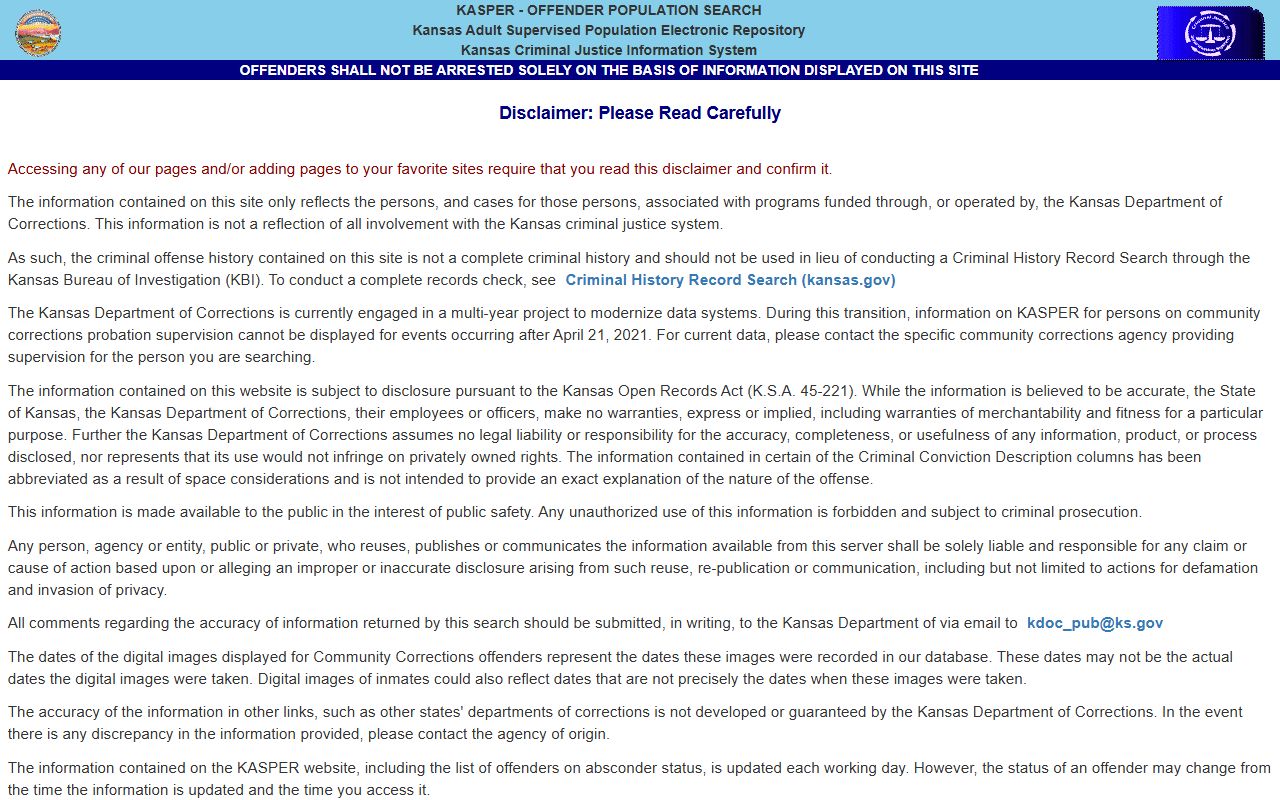
KASPER can point to post-sentence custody or supervision, while the court record explains how the case reached that result.
The KASPER terms page is also part of the official access channel. The assigned capture from the KASPER search disclaimer source reflects the separate terms attached to offender searching.
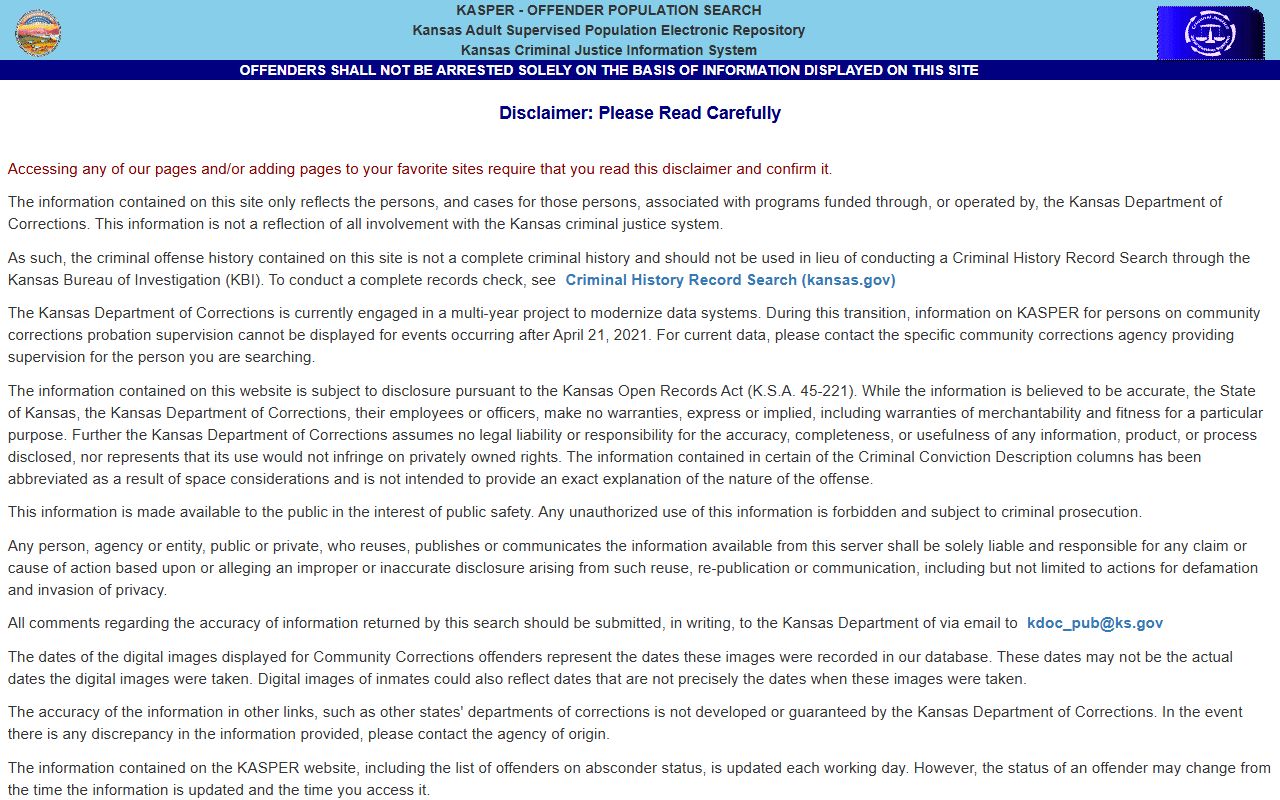
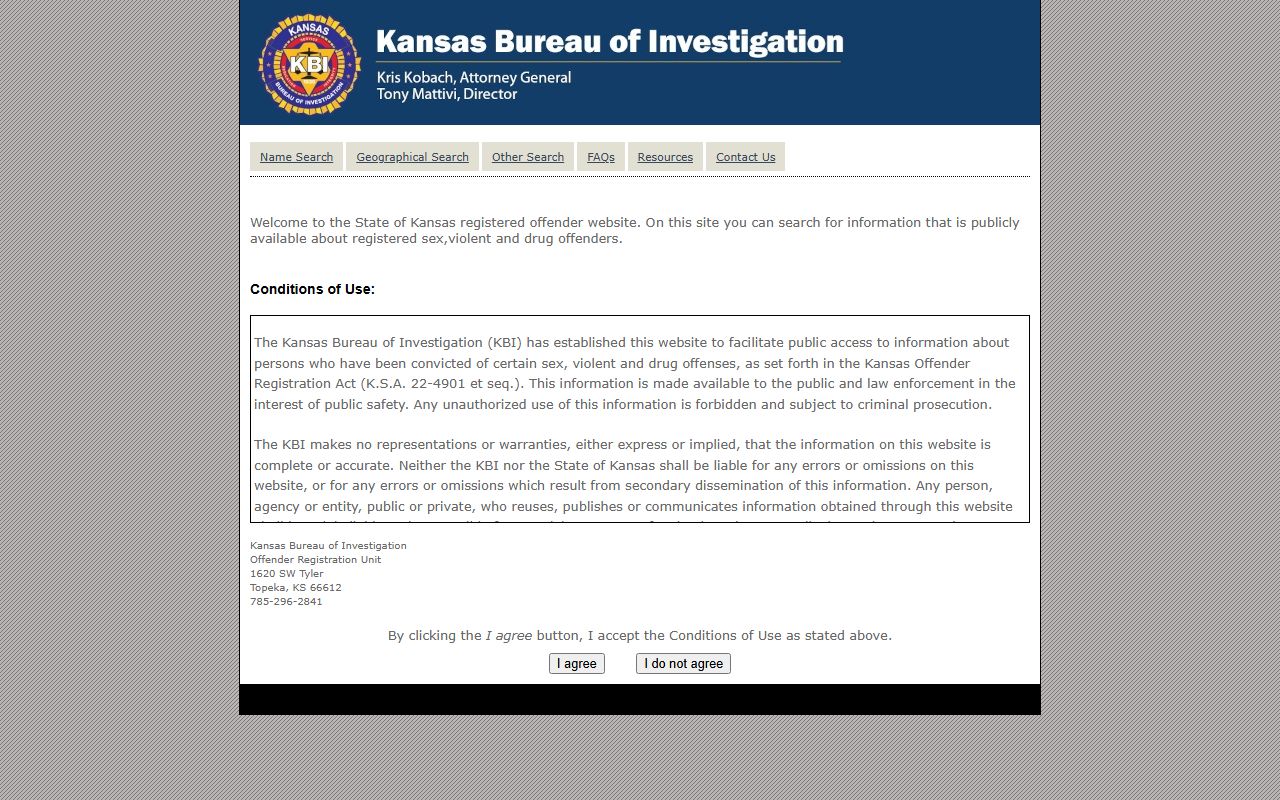
For registered offender information, the Kansas Bureau of Investigation registered offender search is another separate state source with its own disclosure limits.
Sealed vs Expunged Criminal Records
Restricted records require careful language. Sealed records are hidden from normal public access by law or court order. Expungement is a court process that limits public access to eligible records and can allow agencies to respond as if no record exists, subject to Kansas exceptions. Neither term means every agency file, booking entry, or state record disappears automatically.
| Point | Sealed | Expunged |
|---|---|---|
| Public view | Closed from ordinary public portal or terminal access | Public disclosure is limited after a qualifying court order |
| How it happens | By statute, court rule, or judge's order | By petition and court order when Kansas law allows it |
| Agency access | May remain available to the court or authorized agencies | May remain available for statutory exceptions |
| Finney County action | Ask the clerk or court about the sealing order | Identify the case, statute, eligibility, and agency records before filing |
The assigned image from K.S.A. 38-2312 shows the juvenile expungement statute source used for juvenile-record limits.
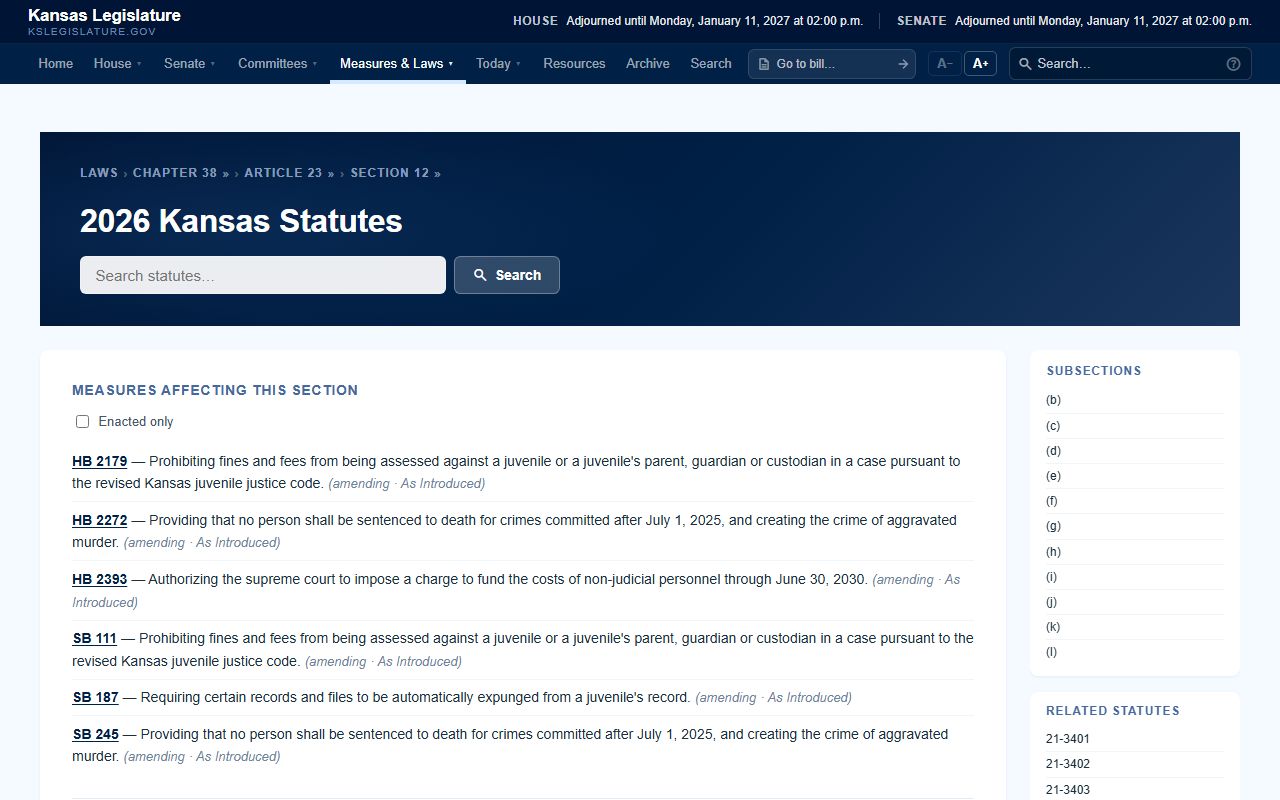
Juvenile expungement has its own petition, notice, waiting-period, hearing, and inspection limits, and serious offenses or registration-required matters may be excluded.
Public Criminal Court Access
Public access to Finney County criminal court records follows Kansas open-records policy and judicial access rules. K.S.A. 45-216 states that public records are open for inspection unless otherwise provided by law. Kansas Supreme Court Rule 22 controls electronic district and appellate case-record access through public portal outlets and courthouse terminals.
K.S.A. 22-4909 is relevant when a criminal case also leads to registered offender information. The statute makes defined registration fields public, but it restricts victim identity, Social Security number, non-conviction arrest history, travel or immigration document numbers, internet identifiers, and website employment-location data.
The assigned capture from K.S.A. 22-4909 anchors that distinction between public offender fields and restricted fields.
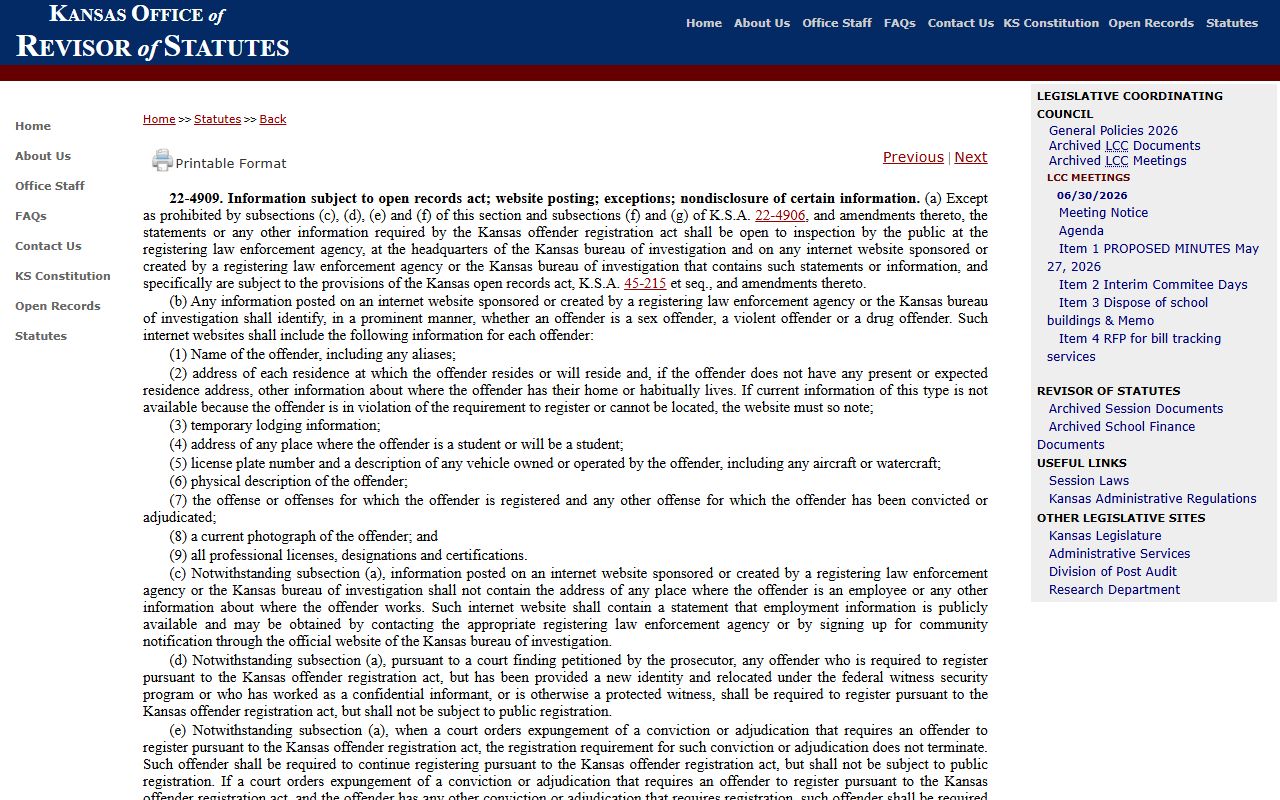
Offender-registration information is not the same as the full court case file. Use it as a separate statutory public-record source.
Restricted Finney County Criminal Records
Juvenile cases, sealed cases, expunged records, victim identifying information, protected personal identifiers, mental health material, and confidential domestic or child-related details may be restricted. A public search result may omit the party name, hide the document, show only limited event data, or show no result at all when the case is not public.
The KBI registered offender search is useful only within its own statutory limits. The assigned capture from the KBI registered offender search source reflects that separate statewide record channel.
For a missing or restricted Finney County criminal court record, contact the Clerk of the District Court rather than assuming the case does not exist. The clerk can explain public access options, but legal advice about sealing, expungement, or eligibility should come from counsel.
Finney County Criminal Clerk Channel
Criminal case copies, certified records, and records not available online route through the Clerk of the District Court. The court phone menu lists traffic and criminal as option 3 when the menu is active. The same courthouse also handles other district court case types, so use the case number, defendant name, and case type when asking for a criminal record.
Clerk of the District Court
425 N 8th Street
Garden City, KS 67846
620-271-6120
Monday-Friday, 8:00 a.m.-5:00 p.m.